Howdy Myco friends, welcome back — Hello from Sri Lanka 🇱🇰

Yesterday marked the first Blue Thursday — a new shopping holiday to celebrate the mushroom industry. It’s long been the guiding premise of this platform that mushroom entrepreneurship and independent business is a viable path forward for both individuals and communities looking to improve their lives while effecting meaningful change in the world.
The legendary Head Magazine published my article highlighting seven different independent mushroom businesses and vendors offering substantial discounts on their products this week. Isn’t it interesting that in an era where ‘fearmaxxing’ has become normalized, inflation is out of control, meaningful and well-paying employment is harder and harder to come by, mental illness has ran amok, and many people are losing hope…that a relationship with mushrooms can offer a tangible, critical lifeline against each of these scenarios? Tap in with the vendors listed in the article below and set yourself up for whatever the future throws our way.

This week’s newsletter is a spotlight on the rare Psilocybe collybioides mushroom as told by legendary mycologists Alan Rockefeller and Mandie Quark. They were my guests on last week’s Mycopreneur Podcast episode, and we’re leading a trip together to Peru in January 2027 in search of this ultra rare mushroom.
The Search For Psilocybe collybioides
Some mushrooms are so rare and enchanting, they require an expedition to the ends of the earth to find them.
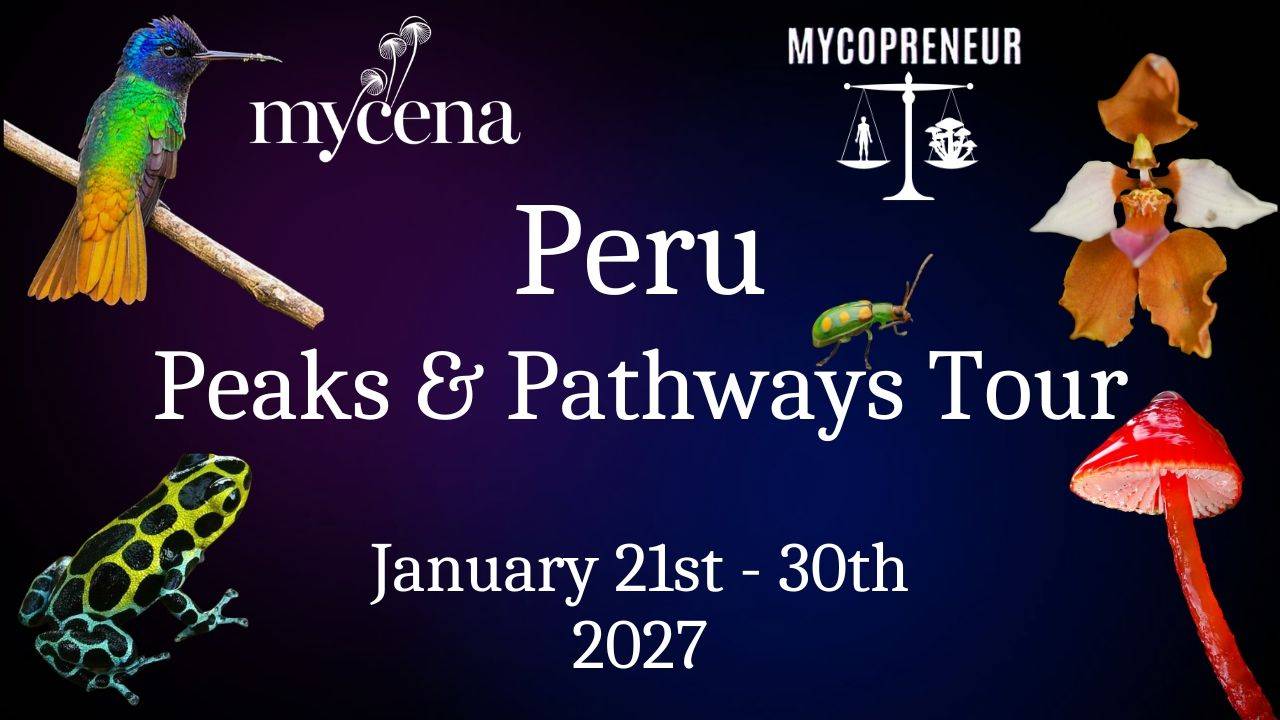
This January 21 - 30, I’m co-leading a foray to the Peruvian Andes alongside renowned mushroom photographer and mycologist Alan Rockefeller and biologist extraordinaire Mandie Quark for a 10-day adventure combining biodiversity exploration, cultural immersion, and a targeted search for one of the world's least documented psychedelic mushroom species: Psilocybe collybioides.

First described by renowned mycologist Rolf Singer in Argentina in 1958, P. collybioides effectively disappeared from the scientific record for decades. Its rediscovery in the Peruvian highlands by Chilean mushroom enthusiast Ivan Perez, followed by DNA analysis and taxonomic research involving Rockefeller and others, has brought this obscure species back into the scientific conversation.
And now, we're organizing an expedition to see if it can be found again.
Rediscovering a Mushroom Lost to History
During last week's Mycopreneur Podcast conversation, Alan explained just how unexpected the rediscovery was.
"Psilocybe collybioides was first described from Argentina in 1958, and then it disappeared from view. Nobody had been thinking about it for a long time."
When Ivan Perez encountered an unusual mushroom growing at high elevation in Peru, he began collaborating with Alan and other researchers to establish its identity. DNA sequencing ultimately produced an extraordinary result.
"We sequenced the DNA, and we sent that DNA sequence to Scott Ostuni in Florida. He noticed that it matched the holotype sequence of Psilocybe collybioides. And when you see a result like that, you're like, what the hell? Is that a mistake?"

Further investigation of the mushroom's morphology, genetics, and habitat helped establish that the identification was legitimate.
Alan emphasized that the species is particularly unusual because of its ecological and genetic characteristics. Despite its striking physical resemblance to certain members of the Psilocybe genus, its closest genetic relatives are surprising.
"This thing is really unique because it only grows at really high elevation areas, and genetically it's really close to Psilocybe cubensis. And that was a big surprise."
Unfortunately, there is another complication. The particular mountain valley where Perez rediscovered the mushroom was subsequently devastated by wildfire.
Mandie Quark explained that the team is now looking toward comparable high-elevation forests in the surrounding region.
"The area where Ivan rediscovered this high-elevation Psilocybe is no longer there. So now we're really on a quest to go to similar habitat, similar forests in the region, and try as hard as we can to rediscover this species."
The possibility that the burned habitat could take decades to recover makes the search particularly meaningful. As Mandie noted, it could potentially take another 40 years for the ecosystem to return to its previous condition.

Beyond One Mushroom: An Extraordinary Biodiversity Hotspot

Photos by Alan Rockefeller
While P. collybioides provides the expedition with a clear quest, the Peruvian Andes offer considerably more than one elusive mushroom.
"There's actually thousands of species of fungi in any forest," he explained. "So we're going to try to get really cool pictures of all of the different fungi there and find not only the big ones, but the tiny ones, the slime molds, and also all of the different plants, insects, moths, animals, and anything alive."
The region is particularly interesting for its diversity of cordyceps fungi, which parasitize insects and other arthropods. Mandie is equally enthusiastic about the area's underdocumented insect populations, including beetles, weevils, and moths.
She plans to bring a dedicated moth-lighting setup to document nocturnal biodiversity, while Alan will lead nighttime ultraviolet forays.
Photography will also be a major component of the expedition. Alan will share techniques ranging from smartphone photography to advanced focus stacking.
Mushrooms, Ancient Architecture, and Andean Culture

The expedition isn't exclusively about fungi. Participants will explore the archaeological sites surrounding Cusco, including Ollantaytambo and Machu Picchu, alongside traditional markets, botanical gardens, native cactus, hot springs, and some of Peru's spectacular natural landscapes.
"This trip is really new. It's different than most of our other trips because most of our trips are, let's just go to one place and look for biodiversity. But we're also going to combine that with a quest to find this rare mushroom, and then also some of your stuff like laughter is medicine ceremony and some cool relaxing at some thermal baths."

January's rainy season is expected to provide favorable conditions for fungal activity, particularly given that it coincides with the time of year when Perez originally discovered P. collybioides.
The itinerary will also incorporate opportunities to experience Peru's extraordinary culinary traditions, indigenous cultural heritage, and landscapes, with some flexibility built in for weather and changing conditions.
Citizen Science and the Future of Mycotourism
One of the most interesting aspects of expeditions organized by Alan and Mandie’s Mycena LLC is their commitment to documenting biodiversity rather than simply observing it.
Each trip establishes a dedicated iNaturalist project where participants can upload photographs and observations, contributing to a growing scientific record.
"For all of our trips, we set up an actual project, and that way we can see exactly what everybody found," Rockefeller explained. "Usually we'll end up seeing more than a thousand species, sometimes more than 2,000 different species between everybody on the trip."
Mandie recalled that a previous two-week Ecuador expedition generated approximately 11,000 observations from 25 participants.
Beyond the scientific contributions, there's also a broader opportunity to support local communities and conservation through responsible ecological tourism.

For Mycopreneur, this is precisely the kind of intersection between mushroom culture, scientific discovery, entrepreneurship, and cultural preservation that deserves more attention.
We're excited to bring together an international community of mushroom enthusiasts for an experience that could contribute to the documentation of an exceptionally rare species while celebrating the remarkable biodiversity and cultural heritage of the Peruvian Andes.
And if we're fortunate enough to encounter Psilocybe collybioides, we'll be among a very small number of people to have ever seen this extraordinary mushroom in the wild.
Join us in Peru!
The Peaks & Pathways Peru expedition is now accepting participants. Visit Mycena LLC to explore the itinerary, reserve your place, and learn more about joining Alan Rockefeller, Mandie Quark, Ivan Perez, and myself on this upcoming adventure.
You don't need to be a professional mycologist to participate. Bring your curiosity, a camera, and an appreciation for the extraordinary world of fungi.