
Live From the International Medicinal Mushrooms Conference 13 in Bragança, Portugal 🇵🇹
“A pandemic is coming, and you in Europe will not have access to Agarikon and Turkey Tail. Why? Because a small group of your regulators decided that it’s a novel food,” warned famed mycologist and mycopreneur Paul Stamets as he stood on stage before an audience of international mushroom industry researchers and stakeholders at the Teatro Municipal de Bragança for the International Medicinal Mushrooms Conference 13.
The European Novel Food Regulation 2015/2283 adopted in 2015 holds that “Emerging technologies in food production processes may have an impact on food and thereby on food safety. Therefore, this Regulation should further specify that a food should be considered a novel food where it results from a production process not used for food production within the Union before 15 May 1997, which gives rise to significant changes in the composition or structure of a food affecting its nutritional value, metabolism or level of undesirable substances.”

“85 to 90 percent of mushroom products on the market are bogus” claims one of the researchers here in his presentation.
Under these regulations, a number of increasingly internationally popular fungi ingredients are restricted for sale in the EU, with a particular emphasis on mycelium-based products.
“Mushrooms are made of mycelium. Mycelium makes mushrooms”, Stamets continued.
“Think of this. Think of your regulators denying the ability of increasing immunity of the population because of a regulatory misunderstanding of the basic biology of mushrooms.”
This conversation regarding the correct identification, labeling, efficacy, and regulation of different parts of the fungal organism and the process by which they are cultivated has been a major point of controversy across the $33 billion + global functional mushroom industry. I should know, as I’ve been caught in the middle of it for some time now; see this Los Angeles Times article from June of 2025 pitting the divergent perspectives of Stamets and fellow mushroom industry titan Jeff Chilton of Nammex regarding accurate fungi parts labeling in mushroom supplement products that I’m interviewed in for a more detailed dive into the complex scenario. The article was inspired by my work covering the mushroom space and this issue of mycelium vs. fruiting body specifically.
The disagreement remains alive and well at IMMC13 in Portugal this week, but fortunately the scope of the programming here goes so far beyond it. I’m giving a keynote here today in three hours and have been wining and dining with the international conference guests late into the night, so a more thorough reporting on the actively unfolding events here will have to wait for next week.

Some of the key points addressed at this conference include the conversation around mushrooms as being ‘multi-target’, medicinally speaking, rather than the traditional pharmacological framing of ‘one drug, one target’ ; this latter approach can sometimes be referred to as the “magic bullet” approach, which assumes that a disease or imbalance in the body can be addressed by finding a single molecular target such as a protein or receptor and modulating it with a single drug.
The current narrative being pushed by biopharmarmaceutical companies like Compass Pathways revolves around this one drug, one target approach, with their particular approach being the development of a proprietary crystalline polymorph psilocybin formulation targeting the 5-HT2A serotonin receptor as a remedy for Treatment Resistant Depression.

A multi-target approach would look more like an individual or a company treating illness by leveraging whole psilocybin mushrooms, which have evolved to harbor a complex synergy of numerous alkaloids — including psilocybin, but also other compounds present in species of psilocybin-containing mushrooms such as Baeocystin, Norbaeocystin, Aeruginascin, Norpsilocin, etc. — to target other receptors such as 5-HT1A, 5-HT2B & 5-HT2C in the brain, liver, stomach, etc.
A whole mushroom approach for a whole system effect.
Speaking of which…today’s one of your last days to grab the Strain of the Month deal from our partners at Full Canopy Genetics. I’d get on that quick if I were you.

I’m gonna be honest with you though, I’m not here to preach science. I’m here at IMMC13 for the evening conversations with the pair of mycopreneurs from India I just met at the Bread & Wine regional cultural heritage immersion experience at the Museo do Abade de Baçal last night, where I learned that Chaga fungus actually grows in Kahmir, India. I also learned that I’ve been pronouncing the primary anti-tumor triterpenoid in the Inonoto Obliquus species incorrectly; it’s actually pronounced ‘Ino-todiol’ , not ‘Inoto-dial’.
I’m here for the sunset party at the Castelo de Bragança, a 14th Century castle built on the hilltop overlooking town where scholars and industrialists commingle against a backdrop of impossibly charming live Fado music while savoring soft regional cheeses like Queijo de Cabra Transmontano, a firm and piquant goat cheese.

And I’m here to advocate for the unsung hero mushroom entrepreneurs across the world — the ones who drive environmental sustainability and cultural preservation in their home regions through diligent enterprise revolving around mushrooms;
Mycotourism efforts that bring money into remote areas where the inhabitants still maintain the dwindling mycocentric customs of their ancestors against the encroachment of urbanization, acculturation, and megadevelopment projects, incentivizing the locals to protect their traditions and biodiverse ecosystem rather than yielding to cultural erasure and razing the forests for monoculture cash crops like soybeans.
Sustainable mushroom farming leveraging Pleurotus (Oyster) mushrooms to help feed and educate regional inhabitants on how to break free from industrialized food systems and create intentional abundance instead of artifical scarcity
Mycomaterials and even houses made out of mycelium materials that enable a community to go beyond the United Nations’ 17 Sustainable Development Goals and instead achieve regenerative practices.
And much, much more.
Product Review
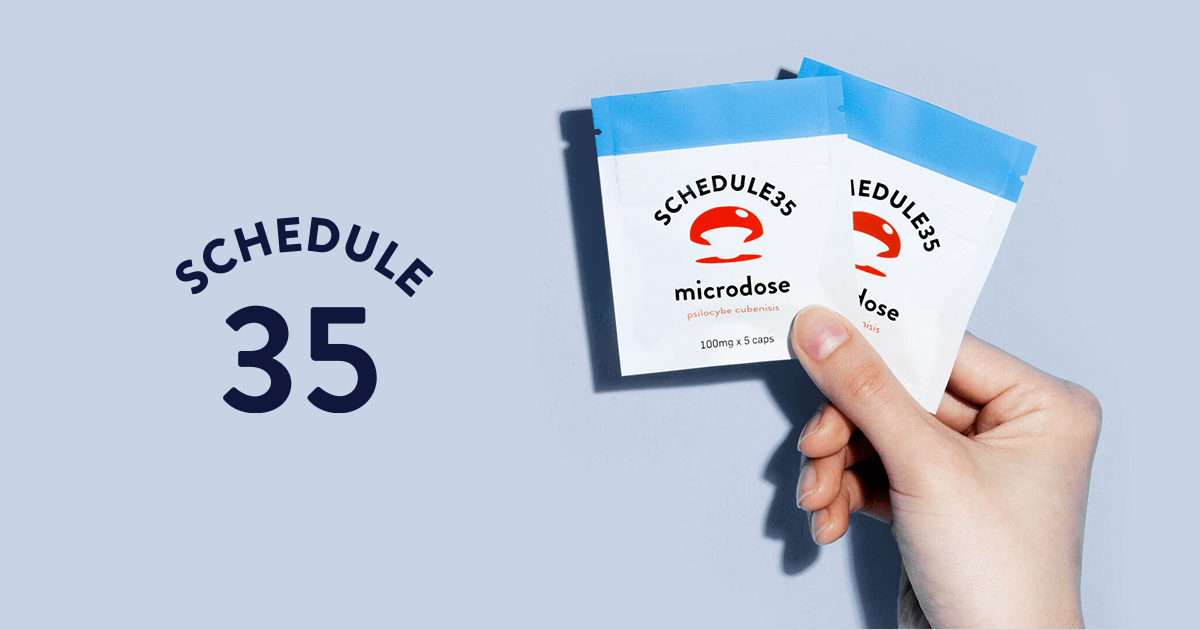
I recently had a chance to try out the microdosing capsules from popular psilocybin mushroom brand Schedule35. Laws around psilocybin vary from country to country, so please ensure that you have researched your local ordinances and are in a position to access these safely before ordering.
I can speak to the quality of the products themselves, which are fantastic. In particular I’m a fan of the very low doses given all the commitments I have these days, and I find that the 100 mg capsules or .25 (half of the .5 gram capsules) can help to elevate my energy levels, focus, and perhaps most importantly and least quantifiably, a ‘resonance’ factor that evokes strong emotions, unlocks memories, and deepens participation in social situations.

Use code MYCO15
Psychedelics Design Conference

The Psychedelics Design Conference & Awards is coming up November 6-7, and it’s going to be a banger.
I’m emceeing the conference and awards for the third consecutive year alongside a prolific roster of global leaders in the worlds of psychedelics and design — this is not one to miss, and it’s online and extremely affordable. People ask me all the time how to get involved in the ‘psychedelics industry’, and the simple truth is that you have to show up to events like this and make yourself known in a tasteful and continuous fashion. so there you go! Grab your tickets below.

Mycopreneur Incubator Today
Today’s Mycopreneur Incubator is being hosted by Donna Gareis , founder of Church of Our Earth.
As always it will be a lively and productive session — invite below.

Topic: Mycopreneur Incubator
Time: Thursday, Sep 24, 2026 03:00 PM America/Detroit
Time to go lock in for this keynote at the conference today —
Obrigado,
DW